

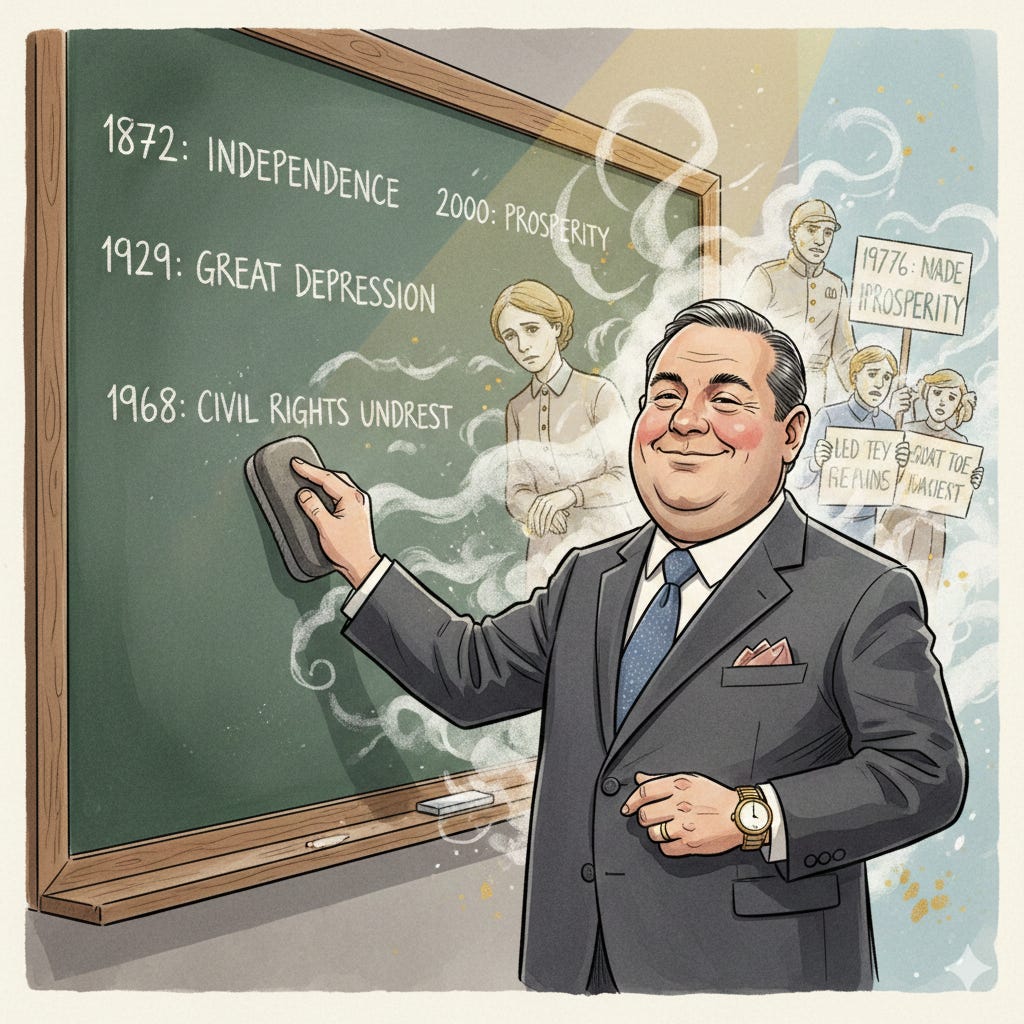
It is a truth universally acknowledged, that a gentleman in possession of political office must be in want of a more agreeable version of history. For what is the past but a series of unfortunate facts, ill-suited to the needs of the present, and entirely too populated with documented evidence? One cannot be expected to govern whilst burdened by the actual sequence of events as they occurred. Such a weight would crush even the most robust constitution, and we must think of the constitutions of our representatives, for they are delicate things, easily strained by accountability.
The practice of selective recollection has reached, in our present age, a refinement that would have astonished even the most accomplished dissemblers of my own era. In my time, a gentleman who wished to obscure an inconvenient truth was obliged to rely upon the natural decay of memory and the merciful absence of recording devices. Today's aspirant to public life enjoys no such organic assistance, surrounded as he is by an infinity of cameras, transcripts, and that most treacherous of modern inventions — the internet archive. And yet, observe how magnificently he perseveres! The contemporary politician, confronted with filmed evidence of his own previous statements, has developed an extraordinary capacity to regard that footage as if it depicted an entirely separate person, perhaps a distant relation of no particular consequence.
Consider the matter of national history itself, which has lately become a subject of considerable legislative interest. In several states, one observes a curious phenomenon: history curricula being revised not to incorporate new scholarship or archaeological discovery, but to address the pressing concern that young people might feel something upon learning what occurred. A certain governor, distinguished by his conviction that education improves when complexity is removed from it, has championed efforts to ensure that the study of slavery, for instance, might acknowledge certain "benefits" gained by the enslaved. One supposes the next revision will note that the passengers of the Titanic enjoyed a memorable voyage with excellent views of the Atlantic. The logic is impeccable, if one's aim is to produce citizens who cannot recognize their own nation's reflection in the glass.
But let us not confine our observations to a single party, for the urge to revise the inconvenient knows no partisan allegiance. History is democratically abused. One encounters gentlemen who speak of the founders as if those wigged figures held precisely the same opinions they themselves expressed that morning on cable television. The founders, conveniently deceased and unable to issue corrections, are made to endorse policies they could not have imagined and, one suspects, would have found bewildering. That many of these same founders held human beings as property whilst writing eloquently of liberty is not, apparently, the sort of complexity we wish students to sit with. Contradictions in great men are rather like contradictions in scripture — best smoothed over by authorities who know what was truly meant.
The art of selective recollection extends beyond curricula into the realm of personal biography. A certain former gentleman of very high office, known for his devotion to the constitution and his documented fondness for documents themselves, has demonstrated a remarkable capacity to recall events in a manner unsupported by the testimony of his own former advisors, his own former attorneys, and occasionally his own former self. When confronted with this discrepancy, his supporters exhibit that most touching of human qualities: loyalty uncomplicated by fact. It is affecting, really. One almost envies such certainty. I have never been so sure of anything as these partisans are sure of everything.
The mechanics of this selective history are now institutionalized. Textbook committees meet in conference rooms to determine which portions of the past shall remain, and which shall be quietly escorted from the premises like an embarrassing uncle at a wedding. The criteria appear to be as follows: Does this fact make anyone uncomfortable? Does it suggest that the nation has at times failed to live up to its stated ideals? Might a young person, upon learning this, ask a difficult question? If yes, excision is indicated. We must protect the youth from the horror of critical thought, which, if left unchecked, might lead to the formation of independent opinions — a development no governing body could survive.
What these revisers fail to understand — or perhaps understand perfectly and fear — is that a nation unable to reckon with its actual history is a nation forever doomed to repeat its most instructive errors whilst congratulating itself on its exceptionalism. It is rather like a gentleman who, having once behaved badly at a ball, insists the event never occurred, and then proceeds to behave identically at every subsequent assembly, baffled each time by the consequences. One cannot correct what one refuses to remember. One cannot improve upon what one pretends never happened. The past is not a buffet from which we may select only the dishes that flatter our present appetites.
And yet I confess I am not without sympathy for the difficulty of these legislators' position. To govern honestly would require acknowledging that many current inequities have roots in policy decisions made by previous officeholders, some of whom share party affiliation with the present incumbents. It would require admitting that progress has been uneven, that justice has been inconsistently applied, that the arc of the moral universe bends toward justice only when sufficient hands are placed upon it to do the bending. Such admissions are not conducive to reelection. And reelection, as we all know, is the highest calling to which a public servant may aspire — higher than service itself, higher than truth, higher certainly than the accurate instruction of the young.
The children, meanwhile, possess a resource their elders may have forgotten: the aforementioned internet. What is excised from textbooks may be found elsewhere, and often is. One imagines the educational authorities will next propose to regulate the search engine, that great democratizer of information, so that it too might be brought into alignment with approved recollection. The project will fail, as all such projects eventually do. History has a stubborn habit of persisting.
For those who cannot remember the past are condemned to repeat it — and those who deliberately forget are merely condemned