

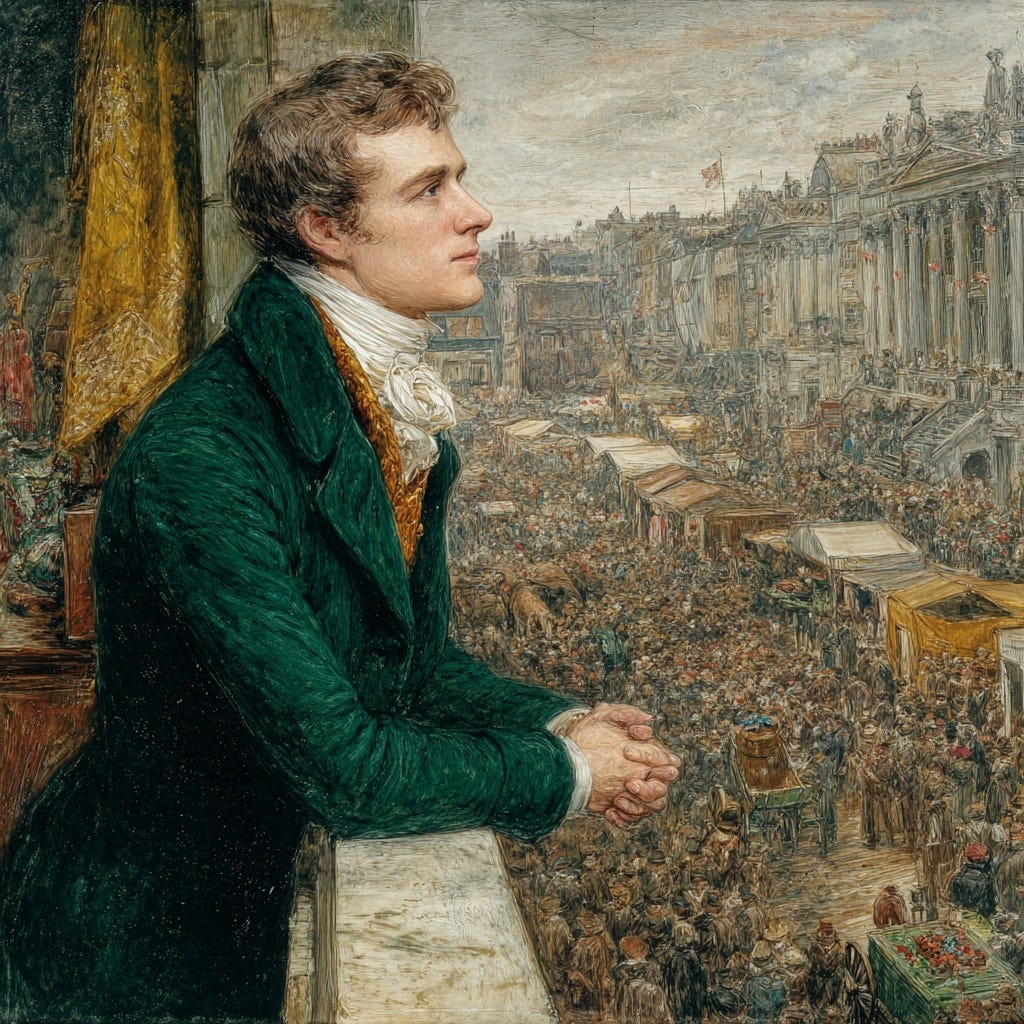
There is a particular kind of confidence that belongs exclusively to those who have never needed to know what things cost. Not ignorance — ignorance can be corrected. Something more settled than that. A lifelong exemption from the arithmetic of Tuesday, accumulated so gradually and so completely that the exemption has ceased to feel like exemption. It has come to feel like the natural order.
Such a man does not know he has it. That is the whole of the thing.
He is not cruel. This bears saying, because cruelty would at least imply some awareness of the gap. What he possesses is something more durable and less dramatic: the unexamined confidence of a person for whom prices are a category of news. They appear in briefings. They are discussed at meetings. They are, on occasion, declared.
To declare a price small is not, for this kind of man, a performance. It is a conclusion he has reached in perfect sincerity, by the only arithmetic available to him — which is to say, the arithmetic of someone to whom the price will not be presented.
The altitude is not acquired all at once. It is built, over a lifetime, from accumulated distances — from the car that is always waiting, the restaurant where someone else reviews the bill, the house in which one has never once calculated whether the heating is possible this month or the groceries or both but not both, never both. Each distance is small in itself. Together they produce a man who has been insulated, by increments so gradual he never felt them, from the entire texture of an ordinary financial life.
This is not a complaint against comfort. Comfort is not the problem. The problem is what prolonged comfort does to a man’s sense of what is normal — and therefore to his sense of what is small. He has not decided that other people’s hardship is irrelevant. He has simply never been required to make it real. The requirement, for him, never came.
The gap between the altitude of declaration and the altitude of payment is not new. It has been a feature of every governing arrangement in every age with sufficient consistency to qualify as institutional. What changes is the vocabulary. Small. Temporary. A manageable disruption. A very small price to pay. The words vary. The grammar is identical. The person speaking is never the person paying.
What is perhaps most interesting — most clarifying — is not the declaration itself but the sincerity behind it. He means it. He has looked at the price from where he stands and it is, from there, genuinely small. The view from that altitude is, in its way, very consistent.
A society that finds this arrangement tolerable has made a calculation of its own, though it rarely states the calculation aloud. It has decided — or rather, it keeps deciding, election after election, with the weary familiarity of a choice that has stopped feeling like one — that the man at the altitude is the appropriate person to determine what the people below it can bear. That his sincerity is sufficient. That the distance is not, itself, disqualifying.
The question a society might reasonably put to itself is not whether such men exist. They have always existed, and they have always governed, and this is not likely to change before the end of the week. The question is what it means that the declaration is issued, and received, and the distance between the issuing and the paying goes, as it invariably does, unremarked.
We are practiced at this. We have the vocabulary for the price. We have never quite developed the vocabulary for the distance.