

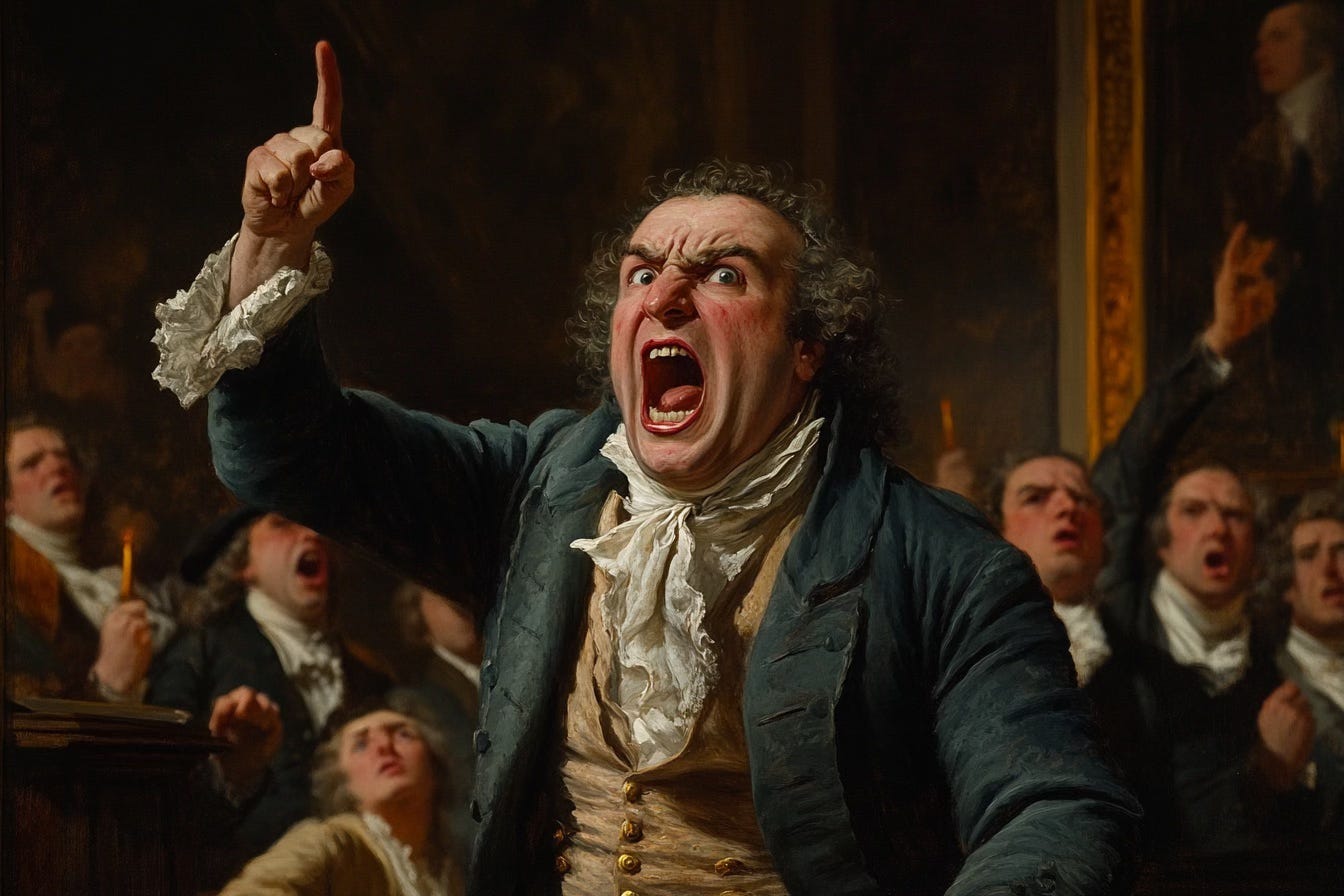
There was a time — not so long ago that it requires mythology, but long enough that it feels like one — when a politician who shouted obscenities at a colleague was understood to have suffered a lapse. An embarrassment. Something to be walked back, if not quite apologized for. The operative word is lapse: a momentary departure from the expected register of public life.
We have arrived somewhere considerably further along.
The lapse, it turns out, was the beginning of a business model.
Observe the contemporary practitioner of what we might charitably call strategic coarseness. He does not lose his temper — or rather, he loses it very deliberately, with an eye on which cameras are running. She does not stumble into vulgarity; she selects it with the care of a sommelier choosing a wine to offed a particular guest. The interruption, the sneer, the raised middle finger on the chamber floor — these are not failures of decorum. They are the product. The constituent received them like dispatches from a war they have been told they are fighting.
Rudeness, once a liability, is now a credential.
The mechanism is not complicated, though it is impressive in its efficiency. A society that has been told — for decades, with great conviction — that its institutions are corrupt, its elites contemptuous and its experts fraudulent will eventually conclude that the behaviors those institutions discourage must be virtues in disguise. Politeness? A tool of suppression. Restraint? Weakness dressed up in good manners. The senator who refused to call his colleague a name is either a coward or, worse, one of them.
Incivility, in this reading, is authenticity. And authenticity, we are assured, is all that matters.
It is worth pausing to note what this argument requires us to ignore.
It requires us to ignore that the loudest champions of unfiltered expression are, themselves, quite filtered — that the outrage is scheduled, the provocations are staffed, the “authentic” moment has been workshopped for maximum clip-ability. The man who brags that he says what everyone is thinking has usually said it on a podcast, clipped it for social media, and sent it to a fundraising list by Tuesday morning. This is not authenticity. This is content production with a rougher aesthetic.
It requires us further to ignore the peculiar selectivity of the rudeness. It flows reliably in one direction: downward, outward, toward those already made to feel their presence requires justification. The wealthy donor does not receive it. The major supporter does not receive it. The rudeness is, like all branded goods, distributed according to market logic. It goes where it costs least and earns most.
And it requires us, perhaps most strenuously, to ignore what manners were actually for. Not — as the current mythology insists — to protect the powerful from criticism, or to enforce a genteel silence over legitimate grievance. But to make it possible for people who profoundly disagree to share a room. To conduct the business of shared life without turning every disagreement into a declaration of war. To acknowledge, however faintly, that the person across from you is a person.
This function is not glamorous. It does not generate content.
A society that mistakes performance for authenticity is an easy one to manage. It can be handed a spectacle and induced to call it accountability. It can be given a villain to boo — a reporter, a colleague, a protester, a neighbor — and forget to ask what is being passed while the booing is in progress. The genius of incivility as political strategy is not that it expressed anger. Anger is free. The genius is that that is consumes anger — burns through it in a controlled environment, leaving the audience spent and satisfied and no closer to anything that might actually trouble the people running the room.
The truly rude thing, of course, would be to say it so plainly.
But that is not the sort of rude that gets clipped.
There is a melancholy irony — the kind that sits at the bottom of a glass rather than the top — in a society that has confused the performance of speaking truth to power with speaking truth to power. The two share an aesthetic. They are otherwise unrelated.
What we have built is a politics of theatrical transgression, in which the appearance of rebellion relieves us of its substance. The audience cheers the raised middle finger. The vote passes. The bill is signed. The cameras cut to the next outrage, and we mistake the cutting for having been somewhere.
Polite society has many faults. It protected too much, questioned too little, mistook comfort for virtue. But it understood, at its best, that shared life requires shared space — and that the first casualty of a world where every norm is negotiable and every restraint a form of weakness is not the powerful.
It never is.