

There is a particular kind of legislation that tells you very little about its stated subject and a great deal about the people who passed it.
Such laws are rarely written in anger — or rather, the anger is incidental. What drives them is something quieter and more durable: the ancient comfort of the designated stranger. Every society, in every age, has maintained one. The particulars shift. The function does not. And when a governing body moves to formalize that stranger’s status — to inscribe their otherness into statute, to route the machinery of the state against them — the interesting question is never really about the stranger at all.
It is about everyone else.
A midwestern state legislature has recently distinguished itself. Not content with the standard repertoire of exclusions — bathrooms cordoned, shelters monitored, the ordinary bureaucratic inconveniences applied to those its members have decided require inconveniencing — it has innovated. It has, in the parlance of the age, disrupted the market.
Citizens may now sue their neighbors not for any harm done, but for the harm of being.
Not the state. Not an agency. Their neighbors. The person in the next stall, the stranger at the sink, the figure in the hallway whose presentation does not satisfy the surveilling eye — any of these may now occasion a lawsuit. The minimum award: one thousand dollars. The plaintiff need not demonstrate harm. They need only demonstrate presence and displeasure.
The governor vetoed this arrangement. The legislature, undeterred, restored it.
One pauses here not to note the governor’s objection — governors object to many things, and the objection itself is not the story — but to note how little it mattered. The machinery had already found its operators.
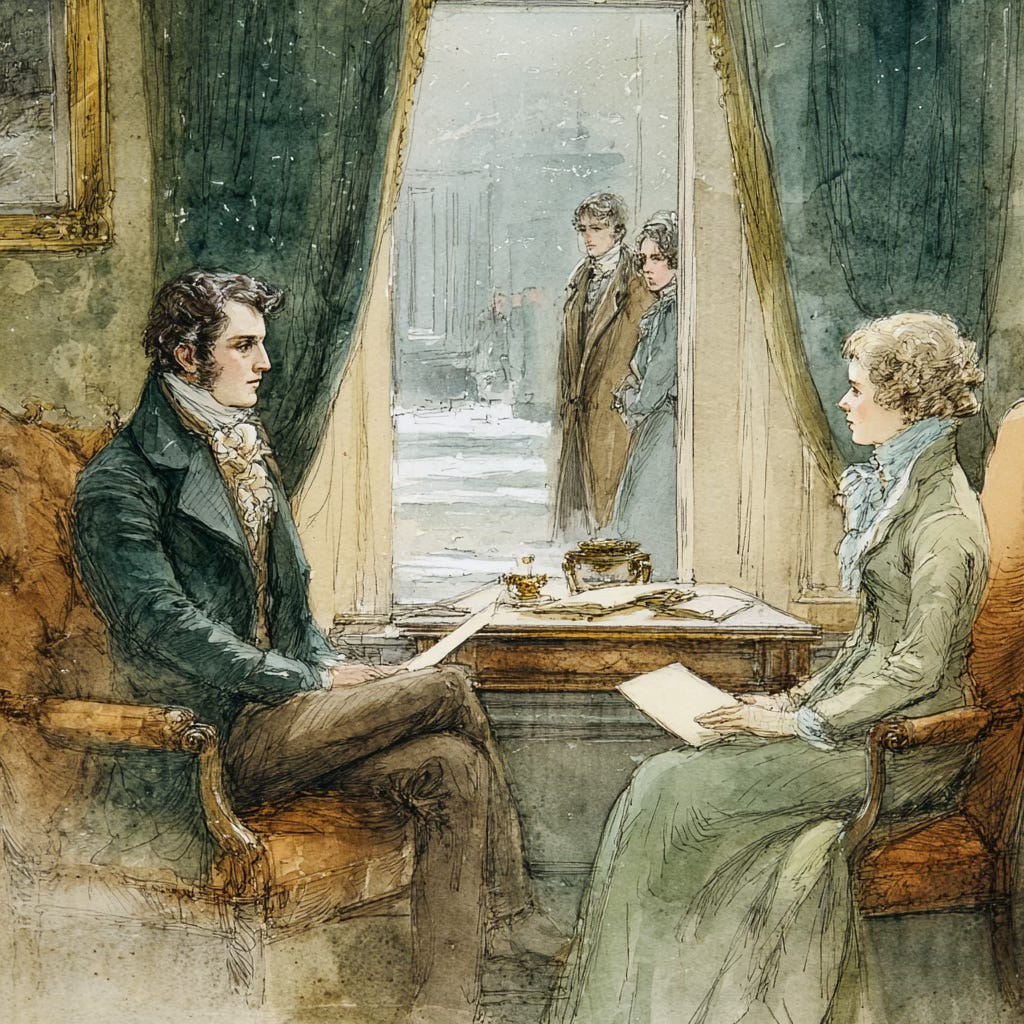
Miss Austen, in her wisdom, understood that the cruelty of a society is rarely concentrated in its villains. Villains are, in their way, almost reassuring — they can be identified, opposed, expelled from drawing rooms. The more unsettling observation, the one she returned to again and again, was that a society’s character lives in its bystanders. In the people who find the arrangement convenient. In those who look away because looking away costs nothing, and looking closer might cost something, and one has rather a lot on at the moment.
A law that deputizes private citizens to financially prosecute one another for the offense of existing in shared space is not, at its core, a law about bathrooms. It is a referendum. It asks: what are you willing to do for a thousand dollars? What are you willing to do for free? What does it tell us that the legislature anticipated willing takers — and appears to have been correct?
These are not comfortable questions. They are, however, the relevant ones.
There is a technique well-practiced by those who would rather their constituents not examine the state of roads, the cost of insulin, the wages that have not moved in a generation. It involves direction of attention — not toward those responsible for such conditions, but toward those made available as explanation for them. The stranger. The interloper. The one whose difference is made to feel like threat, whose existence is made to feel like encroachment.
It is an old technique. It requires a population willing to be redirected. And it works — it works with a reliability that ought to, by now, embarrass us — precisely because it offers something genuine: the satisfaction of a legible enemy, the comfort of grievance with a face attached to it.
A bounty system is simply this technique made liquid. It takes a cultivated social hostility and converts it into a transaction. It makes of suspicion an industry.
And we — meaning the society that produces such legislatures, that returns such majorities, that finds itself in possession of such laws — we do not arrive at a bounty system suddenly. We are walked there, carefully, over years. The walk requires our cooperation. It requires that we remain oriented toward the neighbor in the next stall and away from the man who sold us the map.
There is a word for the emotion one finds oneself inhabiting as one considers all this. It is not quite rage — rage at least implies surprise. It is not quite grief — grief implies something was lost that was securely held.
It is shame. The specific, clarifying shame of recognizing one’s society in an unflattering light and understanding that recognition itself is not absolution. That we have been here before, that we know exactly what it looks like, and that knowing has, once again, proven insufficient.
The thousand-dollar bounty is not the bottom of anything. It is a proof of concept.
One ought not be surprised when a society, having spent years learning to see its neighbors as threats, eventually discovers an appetite for the work.