

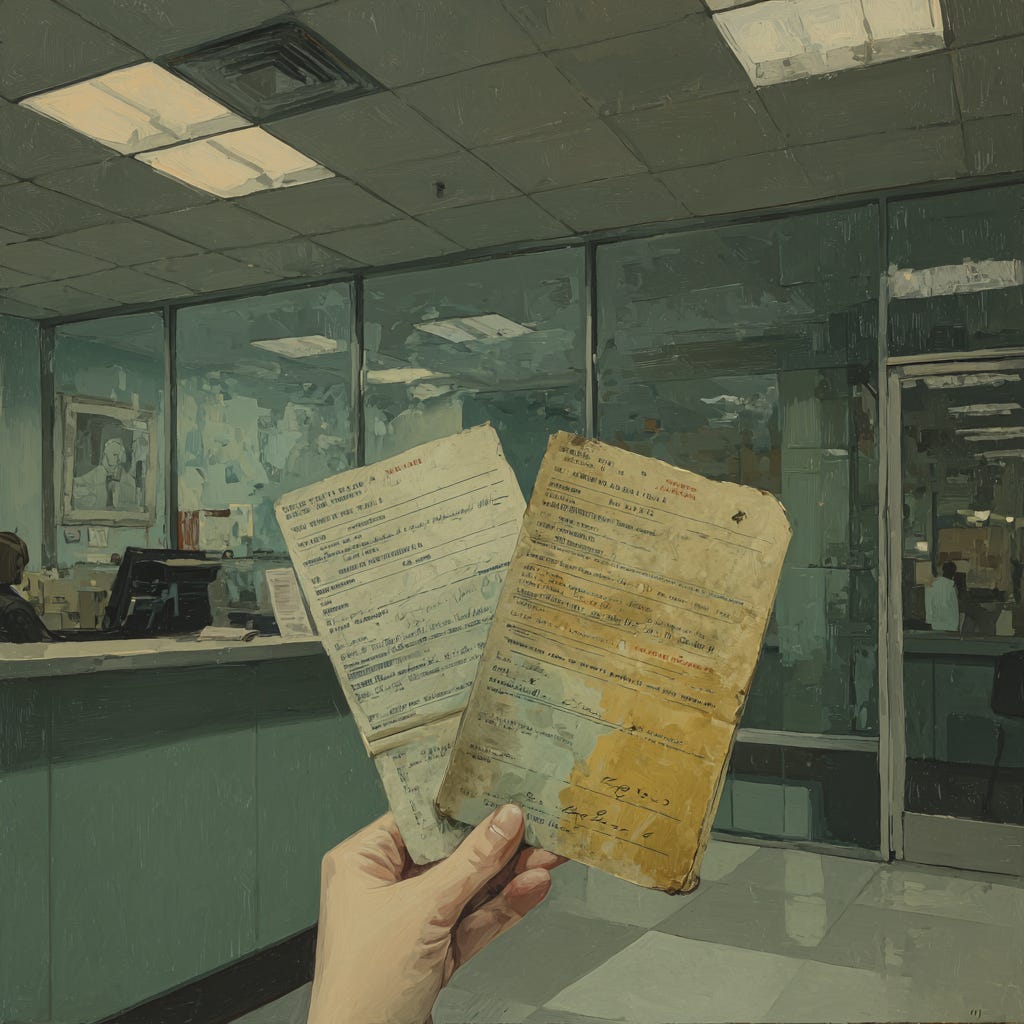
The Safeguard American Voter Eligibility Act — a title of such patriotic amplitude that one hesitates to look too hard at it — proposes something modest. That Americans wishing to register to vote should prove their citizenship. A passport. A birth certificate. Sensible enough, if one does not ask the follow-up questions.
The follow-up questions are where things get interesting.
Approximately sixty-nine million American women do not have a birth certificate that matches their current legal name. They changed it — upon marriage, as roughly eighty percent of women in opposite-sex unions have done, as custom expected and society applauded and no one at the time suggested might one day be used against them. Their birth certificates remember them as they were. Their lives proceeded. And in the distance between those two documents lives, apparently, a discrepancy requiring resolution.
Not a bar to voting, the bill’s architects insist. An extra step. A small administrative matter. Marriage certificate. Court decree. Nothing insuperable for a determined citizen.
Primary season, one notes, does not arrange itself around the determined citizen’s administrative calendar.
The bill passed the House this week. It has stalled in the Senate — not on account of the sixty-nine million women, but because the votes for cloture aren’t there. The distinction is worth sitting with.
What the bill requires, for a woman whose name doesn’t match her birth certificate, is an in-person trip to an election office with documentation that the bill does not specify precisely, to be evaluated by poll workers operating under guidelines that will vary by jurisdiction, in a country where fewer than a third of residents in several states possess a passport and the alternative is whatever secondary evidence the local official decides to accept on the day. The Brennan Center found the bill’s failsafe provision for exactly this situation to be, in their considered assessment, weak. The legal scholars are less reassuring than the press secretaries. This is usually how it goes.
Noncitizen voting — the problem the bill proposes to solve — turned up thirty suspected cases across twenty-three and a half million ballots in one review period. Thirty. The sixty-nine million is not a typo.
There is a class of arrangement that functions not by stating its intentions but by not having to. The names don’t match. The documentation is ambiguous. The burden falls where it falls, and where it falls is not, by some coincidence, evenly distributed.
Women took their husbands’ names because everything around them suggested they should. The state did not object. The church did not object. The social infrastructure of the last several centuries was organized, in no small part, around the assumption that a wife’s legal identity was a reasonable thing to fold into her husband’s. Now the state has determined that documentation of citizenship is best verified against the name one was given at birth — a name which, for sixty-nine million women, no longer appears on anything they carry in their wallets.
The mechanism is tidy. The irony is almost too much to examine head-on. It must be approached sideways, the way one approaches certain difficult relatives at dinner: carefully, with the good china out, pretending not to notice what is directly in front of you.
There is a particular kind of man who is genuinely fond of women — who admires them, flatters them, speaks warmly of his mother and his wife and his daughters — and who nonetheless manages to arrange the world such that women require his assistance to navigate it. He does not consider himself an adversary. He would be wounded by the suggestion. He has simply never thought to ask whether the arrangements he finds convenient might be, for others, something else entirely.
The SAVE Act does not say women may not vote. It says everyone must prove themselves, through a mechanism calibrated around a life pattern most women were socially conditioned not to follow. The discrepancy is not deliberate. It is, in some ways, worse than deliberate — it is incurious. A sustained, historic, bipartisan incuriosity about what it actually costs other people to move through systems designed without them in mind.
Incuriosity, applied to the same populations across the same centuries, stops looking like oversight.
A woman married in 1987. Changed her name — of course she did. Has voted in every election since. Now learns that the name she has been for nearly forty years must be reconciled, in certified copy, with the name on a document from the year she was born, before she had opinions about any of it.
The question the bill’s supporters have not answered — have not, apparently, thought to ask — is what she is meant to do between now and November if the Senate changes its mind.
The expectation was kept. It was not, it turns out, mutual.