

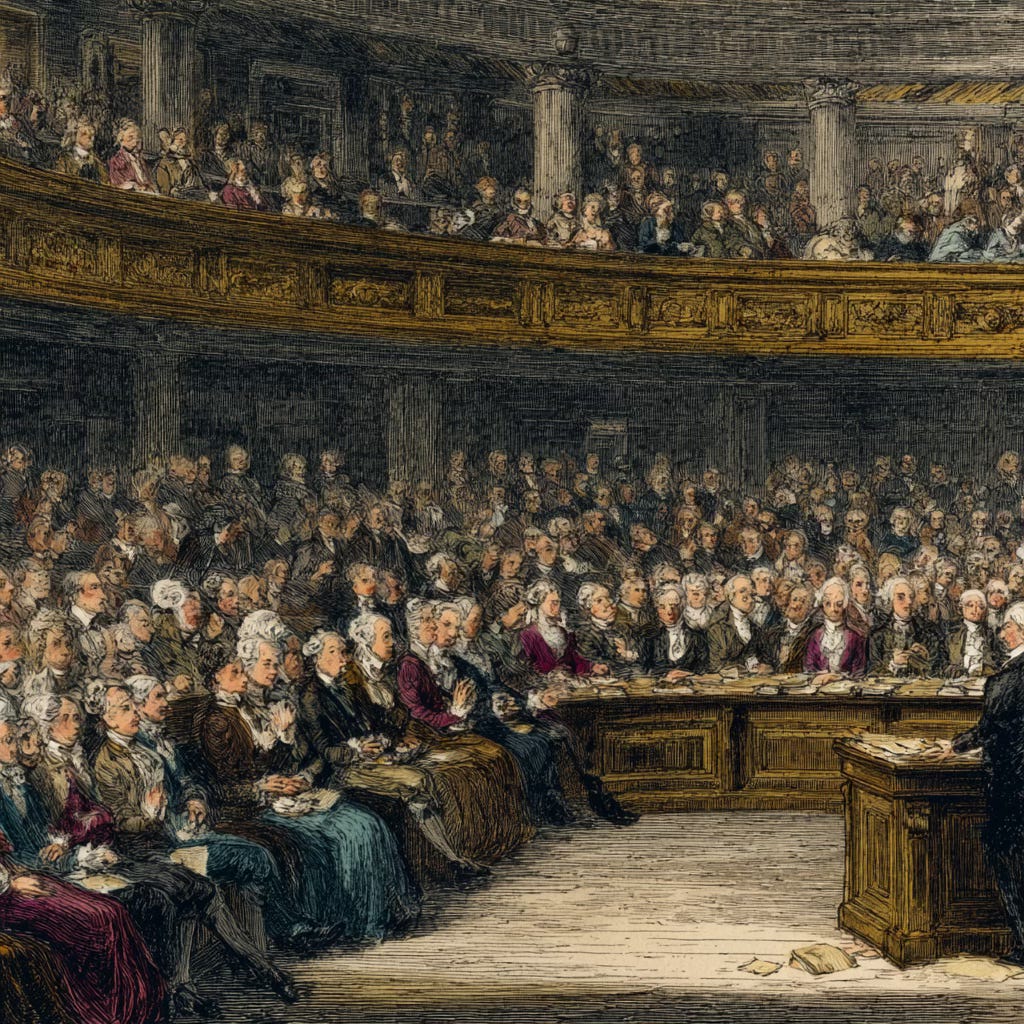
Every society requires its ceremonies, and every ceremony requires its witnesses. What distinguishes the modern political ritual from its predecessors is not the pomp, which remains considerable, nor the tedium, which has always been reliable — but the remarkable degree to which all participants have become simultaneously performer and audience, each watching the others watch them.
The State of the Union address is, at its core, a performance staged for people who are not in the room.
This would not be remarkable. Most performances are. What makes the annual address a particularly fine specimen of political theater is that everyone involved — the speaker, the seated, the standing, the absent — understands this completely, and proceeds anyway with the solemnity of participants in a sacred rite. There is something almost moving about it. Almost.
Tonight, certain members of the opposition have announced their intention to absent themselves from the proceedings. They will not be there. They wish you to know they will not be there. They have, in several cases, issued statements explaining the precise nature and moral weight of their not being there — which is to say, they have performed their absence before the absence has even occurred.
One pauses to admire the efficiency.
The logic, as best one can reconstruct it, runs as follows: to attend is to legitimate; to legitimate is to participate; to participate is to endorse; to endorse is unconscionable. Therefore: do not attend. Announce the non-attendance. Await the coverage of the non-attendance. The coverage arrives. The point is made. The point, naturally, is the same point made by the coverage of those who did attend — namely, that everyone present in this story has strong feelings and would like you to be aware of them.
What the point is not, in either case, is governance.
There is a long and honorable tradition, in bodies of collective deliberation, of the theatrical gesture. The walkout. The empty chair. The turned back. These are the semaphore of political feeling — signals sent across the chamber floor when words seem insufficient or when words have already been said many times and no one listened. One does not dismiss them. They have their place.
Their place, however, is typically the punctuation mark, not the paragraph. When the gesture becomes the primary mode of communication — when absence is announced in advance, scheduled, press-released, and followed up with commentary — it begins to resemble less an act of conscience than a social media strategy with better lighting.
Consider, by contrast, those who will attend. They will sit in their assigned rows. They will rise and applaud at moments predetermined by party affiliation, like musicians reading from the same score. They will wear pins. They will bring guests whose presence is itself a statement. They will stand for some things and remain seated for others, and the camera will find them at both moments, because the camera always finds them, because the camera’s finding them is the purpose of the whole exercise.
The assembled and the absent are, in this sense, doing the same thing. The assembled say: I am here, and I am here on the record, and note what I do with my hands. The absent say: I am not here, and I am not here on the record, and note what I do with my conscience. Both groups are speaking to the same audience — not each other, not the nation in any collective sense, but the narrow, activated, already-persuaded slice of the electorate that will confirm them in their choices and reward them for the gesture.
The speech itself — the actual words, the policy claims, the accounting of the nation’s condition — is almost beside the point. It will be fact-checked within the hour. It will be contradicted by morning. Its promises, if any are made, will be forgotten by spring, by which point new promises will have been required by new circumstances, and the whole machinery will have rolled forward another inch.
This is not cynicism. It is structure.
What is genuinely curious — what any sharp observer of social arrangements might note with particular satisfaction — is how sincerely everyone performs. The speaker delivers the address with conviction. The attendees respond with appropriate theatrics. The absentees issue their statements with gravity. The commentators frame the whole as historic, consequential, a turning point. It is remarkable how much effort the republic expends on a ritual that all parties understand, at some level, to be ritual.
Perhaps that is the point. Perhaps ritual is the point. Perhaps a society that could no longer perform its institutions — even hollowly, even with full awareness of the hollowness — would be in a more serious condition than one that still shows up, or at least shows up to announce that it won’t.
Or perhaps the performance has become so elaborate, the meta-performance so layered upon it, that what we are witnessing is no longer theater but a very long, very expensive rehearsal for a show that no one has quite gotten around to staging.
The State of the Union will proceed tonight as scheduled. The applause will be measured, analyzed, and compared to previous years’. The absences will be counted and assigned significance. The speech will be evaluated for tone and duration. The guests in the gallery will be identified and their symbolism decoded.
And tomorrow, the nation’s condition will be more or less what it was yesterday.
The surest sign that an institution has outlived its purpose is that its participants become more interested in how they are observed performing it than in what the performance is for.