

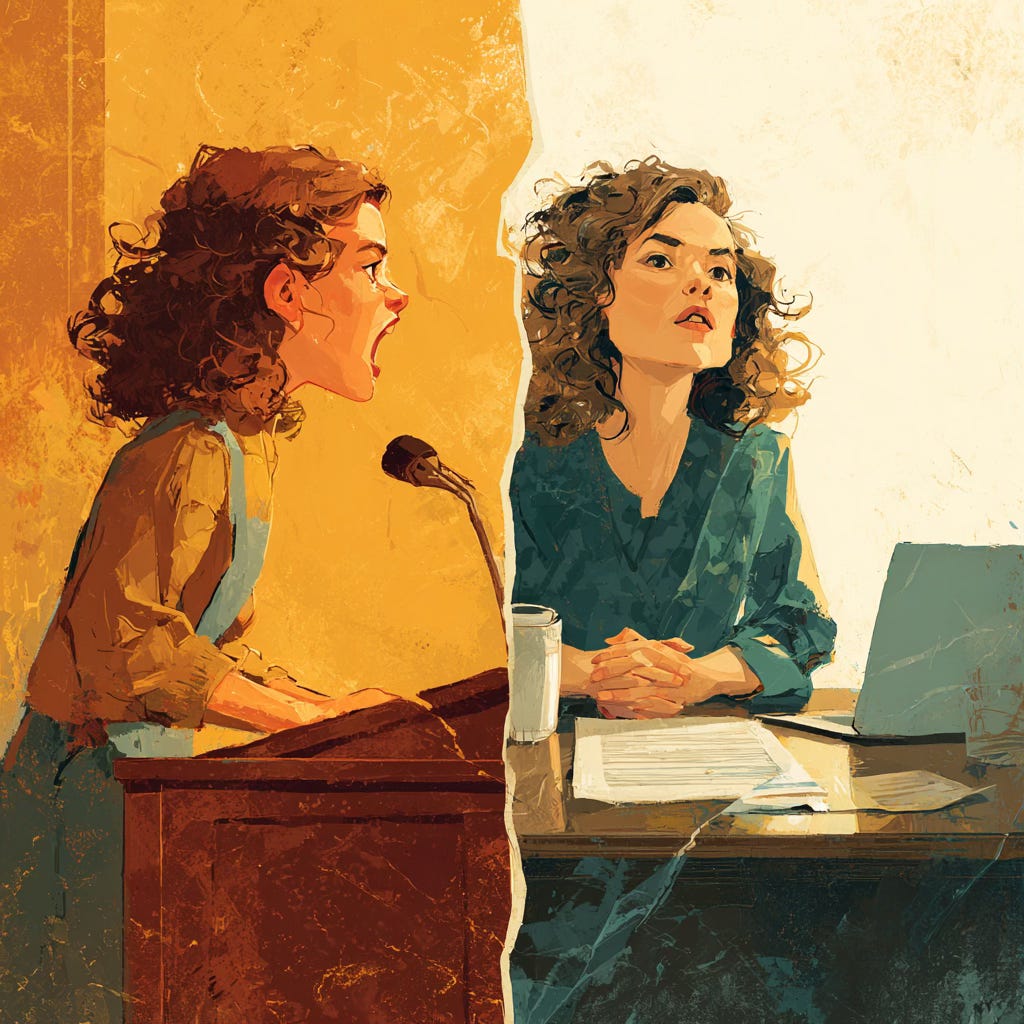
It is a truth acknowledged, if rarely spoken aloud, that the person most likely to understand the mechanics of a cage is the one who built it themselves, board by board, in full knowledge of what they were doing.
We speak often of courage — celebrate it in the young with the easy generosity of those who are not yet required to pay its costs. The fifteen-year-old who stands at a school board meeting and says the uncomfortable thing, the nineteen-year-old who signs the petition before the ink is dry, the twenty-two-year-old who writes the letter that burns the bridge — we look upon these creatures with either admiration or irritation, depending upon whether they are inconveniencing us, but we rarely look upon them with envy. They have nothing to lose, we tell ourselves. It costs them nothing.
We do not examine, with any particular rigor, what it will one day cost them to stop.
The present era has produced, among its many remarkable achievements, a class of individuals whom one might describe as the Professionally Silenced. They are not, it must be noted, silenced by any external force — no one has arrived at their door to remove their tongue. They have, rather, performed this service for themselves, with impressive efficiency, and at considerable savings to whatever authority might otherwise have been required to do it. The mortgage is paid. The clients are retained. The position is secure. The tongue rests.
What makes this particular silence so exquisite a subject for study is not its existence — silence among the comfortable is as old as comfort itself — but the specific quality of shame that attends it. There is a species of person alive today who can recall, with uncomfortable precision, exactly when they stopped. They remember the argument they did not make at the dinner table because a certain guest was present. They remember the post they drafted and then deleted, not because it was false, but because it was visible. They remember the colleague whose politics they found contemptible and whom they nonetheless smiled at, because the contemptible colleague controlled something they needed. They carry these memories the way one carries a stone in a shoe — not incapacitating, but impossible to forget entirely.
This is distinct from the ordinary evolution of opinion, which we must not confuse with its counterfeit. There are those who encounter new information and revise their understanding — this is admirable and should be encouraged. There are those who, upon reflection, conclude that the positions of their youth were arrived at with insufficient care — this too is reasonable. But there is a third category, and it is this third category which interests us, for it is populated by individuals who do not believe they were wrong. They believe they were right. They remain right, quietly, in private, at great personal cost to the part of themselves that used to say so.
The contemporary political atmosphere has been unusually productive in generating members of this category. One observes, with the eye trained to notice such things, a government that has managed to make an unremarkable number of citizens feel simultaneously enraged and very, very careful. There are tariffs being announced and retracted and announced again at a frequency that would exhaust a reasonable mind; there are agencies suspended and unsuspended over a single weekend as though governance were a form of recreational theatre; there is a Supreme Court ruling that a thing was unlawful, and an executive response that the unlawful thing shall simply be made lawful by announcing it more firmly. In the midst of all this, the reasonable citizen sits at their desk and calculates, not what is right, but what is safe to say.
The young are watching this calculation. They are excellent observers.
The particular cruelty of the situation — and here one must pause to appreciate its architecture — is that the silence is entirely voluntary and entirely coerced simultaneously. No one is told to be quiet. They are simply shown, repeatedly, what happens to those who are not. A person with a professional license, a mortgage, a contract, a pension, a reputation constructed over decades — such a person finds that honesty has acquired a price they did not initially agree to pay. This is not a new mechanism. It has been employed with considerable success throughout recorded history. Its genius lies in requiring no enforcement whatsoever. The citizen becomes their own censor, and does so with a thoroughness no external authority could match, because no external authority knows quite where all the edges are.
What the fifteen-year-old did not know, standing at that podium, pen hovering over that petition, finger about to send that message — was that the cost of speaking would one day be measured not in detention or disapproval or lost friendships, but in money. Money is an unusually effective argument. It does not shout. It does not need to. It simply sits there, radiating practicality, while the other arguments exhaust themselves.
The result is a society in which the most informed citizens — those old enough to have watched the pattern repeat, those educated enough to name it, those experienced enough to understand its consequences — are precisely the ones most likely to say nothing. They have too much to protect. They have spent twenty, thirty, forty years building something and they will not set it on fire for the satisfaction of being on record. The young, who have built nothing yet, speak freely and are dismissed as naive. The old, who have built everything, speak carefully and are praised as measured. This arrangement suits certain interests rather well.
One does not, ultimately, need to explain the mechanism. The mechanism explains itself, in the quality of the silence, in the studied blankness of faces in rooms where something unspeakable has just been said and everyone present knows it and no one says so.
The fifteen-year-old who used to speak would not recognize us. We would prefer, on balance, that they not try.
It is a curious feature of moral courage that it is always most available to those who cannot yet afford to lose it — and most needed from those who can.