

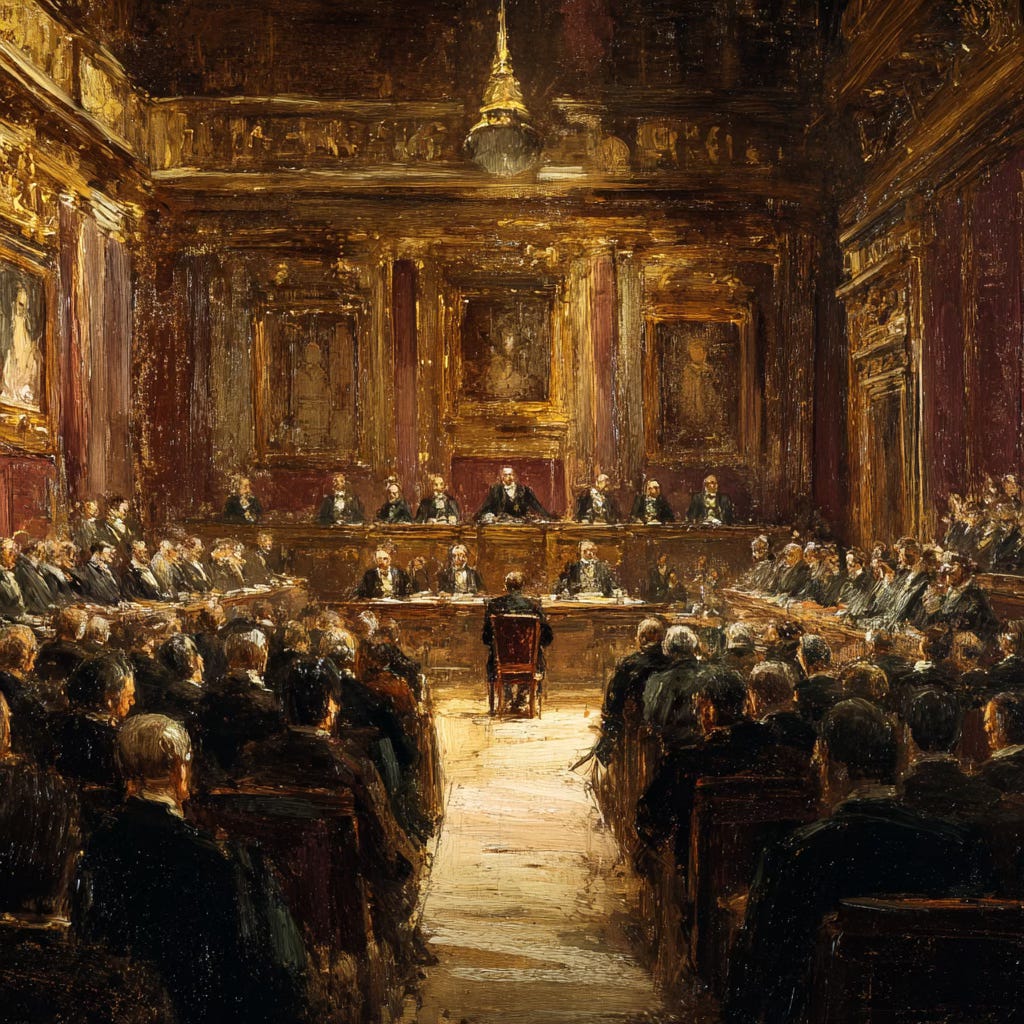
There is a particular kind of official inquiry that announces its conclusions before it begins. Not in writing — such things are rarely written. Rather, the announcement is structural. It lives in who is summoned, and who is not. In what is on the record, and what remains, by mutual and unspoken agreement, off it.
The House Oversight Committee has recently produced a masterwork of the genre.
Former President William Jefferson Clinton — a man disbarred for giving “false and misleading” testimony under oath, on the specific subject of his conduct with women — was this week invited to testify under oath, on the specific subject of his conduct with women. He testified for six hours. He said he saw nothing. He said he did nothing wrong. He said — and one must pause here to fully appreciate the architecture of the statement — that had he known what Jeffrey Epstein was doing, he would have turned him in himself.
This from a man who flew on Epstein’s plane multiple times. Who appeared in the released files in photographs whose provenance and date remain conveniently unclear. Who continued his acquaintance with Epstein after the man’s first conviction.
The committee chairman, for his part, was careful to note that no one is accusing the Clintons of any wrongdoing.
No one is accusing them. They were simply subpoenaed — threatened with contempt, with criminal charges, with the full weight of congressional authority — in service of an investigation that accuses them of nothing.
One is expected to find this coherent.
The theater of moral reckoning in polite society has always had a simpler goal than it advertises. The goal is rarely accountability. The goal is the appearance of having attempted it. There is a crucial difference. Actual accountability requires following the evidence wherever it leads — an uncomfortable, undiscriminating process, no respecter of party affiliations or prior alliances. The appearance of it, by contrast, can be achieved quite efficiently, so long as one selects one’s witnesses with care.
The selection here has been instructive.
The Clintons were subpoenaed. They resisted for six months, were threatened with contempt, and ultimately submitted to closed-door depositions that the committee chairman had already characterized as unlikely to produce accusations. Meanwhile, the sitting president — whose name appears in the Epstein files as frequently as anyone’s, whose social history with the convicted financier spans a decade of very well-documented public appearances — was asked nothing. His Commerce Secretary, who has acknowledged visiting Epstein’s private island, submitted a written statement.
A written statement. The Clintons, by comparison, gave roughly thirteen hours of filmed testimony between them.
One does not need to be sympathetic to the Clintons to notice that the investigation appears to have been designed with a preferred answer already in mind — and that the preferred answer is not, in fact, about Jeffrey Epstein’s victims at all.
There is a move available in legislative proceedings that has no formal name, though it perhaps deserves one. It involves the construction of accountability theater so elaborate, so procedurally exhausting, that the audience loses track of what it was originally watching. Subpoenas are issued. Contempt votes are held. Six-hour depositions are conducted in performing arts centers in Westchester County. Video is promised and perhaps released. The machinery of inquiry makes its satisfying sounds.
And throughout, no one is accused of anything.
The Democratic members of the committee, to their credit, identified the maneuver promptly. They pointed out — with a regularity that suggested they knew it would not work — that if former presidents may be compelled to testify, the current president might also be so compelled, given that he appears in the files rather extensively. This observation was received with the enthusiasm one might expect.
It was not, however, wrong. It was, in fact, the only observation in the entire proceeding that threatened to be genuinely inconvenient to anyone.
Which is, perhaps, why the hearing was constructed the way it was.
The former president’s opening statement contained a sentence that deserves preservation. He said — and he said it under oath, to members of Congress, on camera — that he “would have turned Epstein in” himself had he known. That he would have “led the call for justice.”
This is a man who has led very few calls for justice in his career and several calls for rather the opposite. This is a man whose relationship with the truth in sworn proceedings has a documented, adjudicated history. This is a man who, by his own account, traveled with Epstein, socialized with Epstein, and appeared in Epstein’s files with such frequency that the committee required a full day to work through the photographs.
He saw nothing. He did nothing wrong.
Perhaps. One cannot say with certainty. The committee chairman has already confirmed he will not be accusing anyone.
But there is a separate question — not of guilt, which is the committee’s domain, but of credibility, which is ours. The question of why, of all the witnesses one might construct an accountability hearing around, this particular man’s testimony, on this particular subject, is what the republic has spent a Friday consuming.
The answer, one suspects, has less to do with justice than with the comfortable displacement of the question of justice onto a figure who has long served as a reliable lightning rod. He is, in this sense, a gift — not because he is guilty of the thing he is being asked about, but because his presence allows everyone to feel that something is happening while nothing is at risk.
The investigation will not find what it is not looking for. The witnesses most likely to complicate that arrangement were not asked to appear. The one who was asked — who testified for six hours that he saw nothing and did nothing wrong — is a man whose assurances on this subject no one with a working memory has any particular reason to trust.
A hearing designed to produce no findings, featuring a witness selected for his notoriety rather than his relevance, conducted by a committee whose chairman has pre-exonerated its subjects — this is not accountability.
It is its understudy. Convincing enough, from a distance, to satisfy an audience that was never really asking for the genuine article.
The victims of Jeffrey Epstein are owed something considerably more than this. That they will not receive it from this proceeding was, one suspects, the point.